December 2026 (1)
- Dec.
01
- 2026
IEEE NL OES-GRSS-APS invited APS YP Talk
2026-12-01T17:30:00.000Z,
2026-12-01T17:30:00.000Z
–
2026-12-01T18:30:00.000Z
Virtual
Hosted by Newfoundland-Labrador Sect Jt.Chap,OE22/GRS29/AP03
Speaker: Dr. Kamil Yavuz Kapusuz
Title:From Chip to System: A Holistic Approach to 2D Scalable Low-Loss D-Band Active Phased Array Realization
Abstract: The relentless demand for multi-gigabit wireless communication and high-resolution sensing drives rapid innovation in D-band (110–170 GHz) systems. However, realizing efficient and scalable active phased arrays at these frequencies remains challenging due to high cost, interconnect losses, packaging parasitics, and heterogeneous integration constraints. This talk presents a holistic, system-level approach to low-loss D-band phased array integration that unifies circuit, antenna, and packaging co-design. Leveraging both silicon-based (CMOS, SiGe) and III–V integrated circuits, the approach emphasizes optimized beamformer and power amplifier architectures combined with low-cost 2D scalable, wide-angle scanning wideband antenna arrays implemented using low-cost PCB processes. Through electromagnetic co-optimization and advanced interconnect engineering, the framework achieves significant reduction in loss and improvement in overall system efficiency. Measured D-band results from prototype modules demonstrate wide-angle beam steering and data transmission rates up to 100 Gb/s. These results confirm the feasibility of steerable, high-capacity arrays suitable for both communication and sensing platforms.
Short Bio: Kamil Yavuz Kapusuz (Senior Member, IEEE) received the M.Sc. degree in Electrical Engineering from Atilim University, Ankara, Turkey, in 2013, and the Ph.D. degree in Electrical Engineering from the Electromagnetics Group, Department of Information Technology, Ghent University, Belgium in 2021.
From 2014 to 2016, he worked as a Senior Antenna Engineer at Remote Sensing Technologies, Turkey. Between 2021 and 2022, he was a Visiting Scientist at the CNRS, IETR Laboratory, France. Since 2022, he has been a Senior Researcher in Electromagnetics at IMEC and Ghent University. His research includes on the analysis and design of quasi-optical systems, leaky-wave antennas, near-field focusing techniques, in/on-body communication systems, active/reconfigurable/unconventional millimeter-wave and sub-terahertz phased arrays, and electromagnetic modeling and optimization of 2.5D and 3D RF packaging architectures.
Dr. Kapusuz received the URSI Young Scientist Award at the 2021 URSI General Assembly.
Time: 2pm-3pm NST, 1 December, 2026
Webinar Link: https://mun.webex.com/meet/weimin
Webinar link: https://mun.webex.com/meet/weimin
Save to calendar:
November 2026 (2)
- Nov.
12
- 2026
NECEC 2026 - Sponsor Registration
2026-11-12T11:30:00.000Z,
2026-11-12T11:30:00.000Z
–
2026-11-12T20:30:00.000Z
Holiday Inn St. John's Conference Centre, Room , 180 Portugal Cove Rd.
Hosted by Newfoundland-Labrador Section
NOTE: This is the Sponsor Registration Page. For attendee registration, click here.
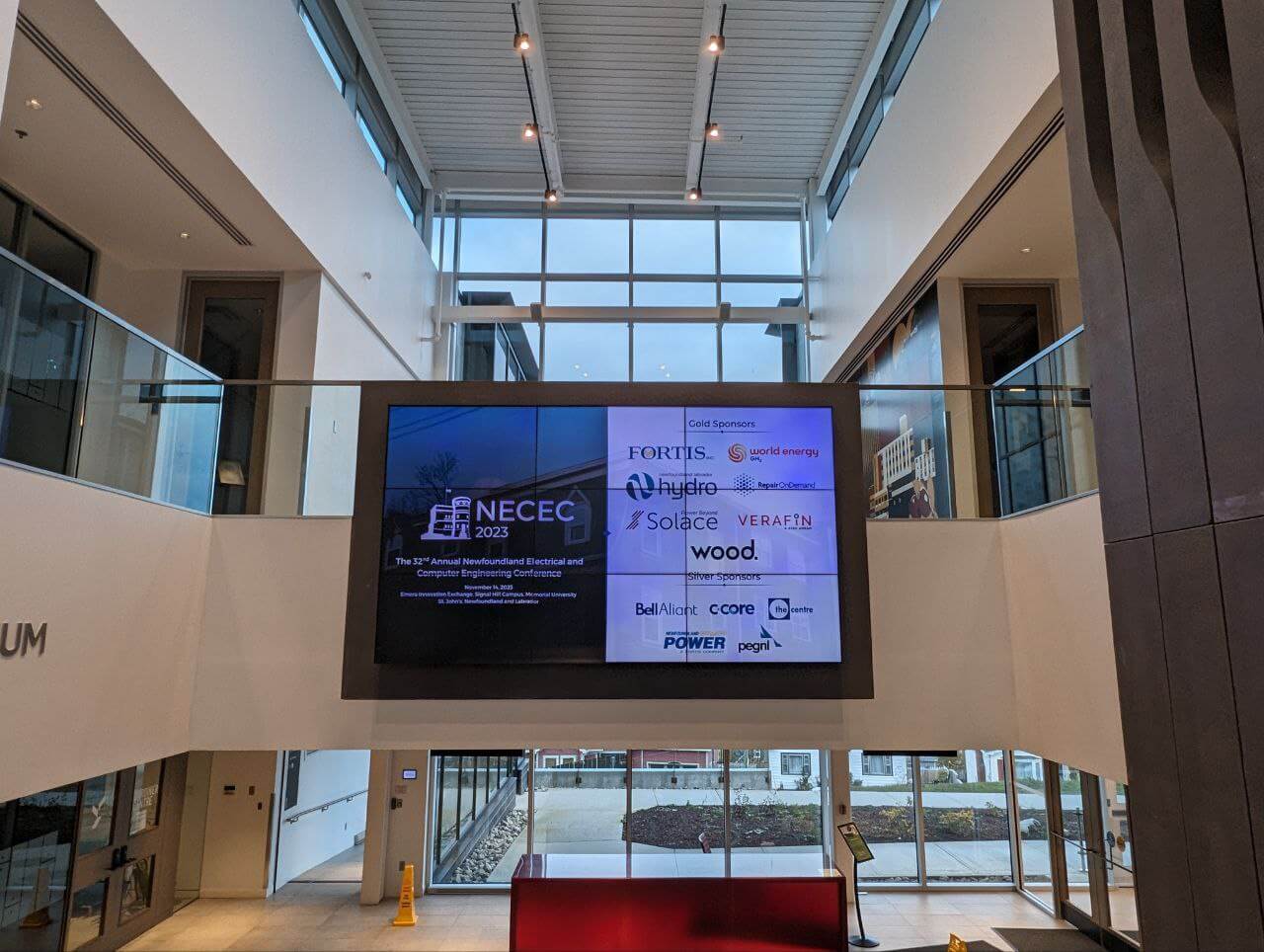
NECEC is presented by IEEE Newfoundland and Labrador Section in cooperation with Memorial University of Newfoundland as a forum where professionals in electrical, electronic and computer engineering as well as information technologies can present their work to the growing technical community within the province. The conference will focus on technical concepts, innovations and implementations.
Registered conferees will be provided with lunch, refreshment breaks, and conference proceedings.
Proceeds from this event and past conferences are used to sponsor IEEE Scholarships, which are awarded to students in Terms IV and VI of the Electrical Engineering or Computer Engineering program at MUN.
More information about this event can be found at the event website.
Save to calendar:
- Nov.
12
- 2026
NECEC 2026
2026-11-12T11:30:00.000Z,
2026-11-12T11:30:00.000Z
–
2026-11-12T20:30:00.000Z
Holiday Inn St. John's Conference Centre, Room , 180 Portugal Cove Rd.
Hosted by Newfoundland-Labrador Section
NECEC is presented by IEEE Newfoundland and Labrador Section in cooperation with Memorial University of Newfoundland as a forum where professionals in electrical, electronic and computer engineering as well as information technologies can present their work to the growing technical community within the province. The conference will focus on technical concepts, innovations and implementations.
Registered conferees will be provided with lunch, refreshment breaks, and conference proceedings.
Proceeds from this event and past conferences are used to sponsor IEEE Scholarships, which are awarded to students in Terms IV and VI of the Electrical Engineering or Computer Engineering program at MUN.
More information about this event can be found at the event website.
Save to calendar: